In precision measurement applications — force testing, torque characterization, structural load monitoring — it matters quite a bit. Misunderstanding the distinction leads to specification errors, incompatible signal outputs, and measurement systems that don't perform as expected.
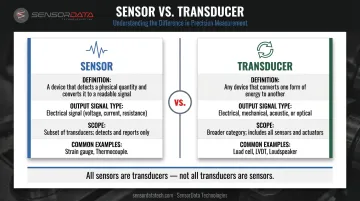
The short answer: a sensor detects a physical quantity and responds to it; a transducer converts energy from one form to another. All sensors are transducers, but not all transducers are sensors. That logical relationship is the foundation everything else builds on.
Key Takeaways
- Sensors detect physical changes (force, temperature, pressure) and produce a proportional output signal
- Transducers are the broader category, converting energy from one form to another (mechanical to electrical, for example)
- All sensors function as input transducers; output transducers (motors, loudspeakers) are not sensors
- A load cell is a transducer assembly that contains strain gauges as its internal sensing elements
- The terms are frequently used interchangeably in industry; focus on the full signal chain, not the label
Sensor vs. Transducer: Quick Comparison
| Category | Sensor | Transducer |
|---|---|---|
| Definition | Detects or measures a physical quantity | Converts energy from one form to another |
| Output Signal | Resistance, capacitance, or voltage change | Defined electrical output (mV/V, voltage, current) |
| Scope | Narrower — a specific type of transducer | Broader — includes sensors and actuators |
| Common Examples | Strain gauge, thermocouple, photodiode | Load cell, torque transducer, LVDT, loudspeaker |
| Industrial Use | Embedded sensing element in a larger assembly | Complete measurement or actuation device |
Note: In practice, manufacturers and engineers frequently use "sensor" and "transducer" interchangeably. A "load cell" and a "force transducer," for instance, often describe the same device — the label depends on the manufacturer, industry, and application context.
What Is a Sensor?
Per the JCGM 200:2012 International Vocabulary of Metrology (VIM), a sensor is "the element of a measuring system that is directly affected by a phenomenon, body, or substance carrying a quantity to be measured." NIST narrows this further, defining a sensor as "a transducer that converts a physical, biological or chemical parameter into an electrical signal."
The key word is element. A sensor is often a component within a larger device, not necessarily a standalone measurement instrument.
Active vs. Passive Sensors
This distinction matters for circuit design and signal conditioning:
- Active sensors require external excitation to produce an output. A strain gauge is the classic example — it needs a supply voltage across a Wheatstone bridge to detect resistance changes caused by deformation. NI's documentation on strain gauge measurement confirms that bridge-based sensors require this excitation to function.
- Passive sensors generate their own output from the stimulus alone. A thermocouple produces voltage from heat via the Seebeck effect — no external power required, as Analog Devices explains.
Identifying which type you're working with shapes every downstream decision — from conditioning circuit architecture to power supply sizing.
Sensors in Industrial Settings
Sensors appear throughout industrial measurement processes, typically embedded within a larger transducer assembly rather than operating as standalone devices:
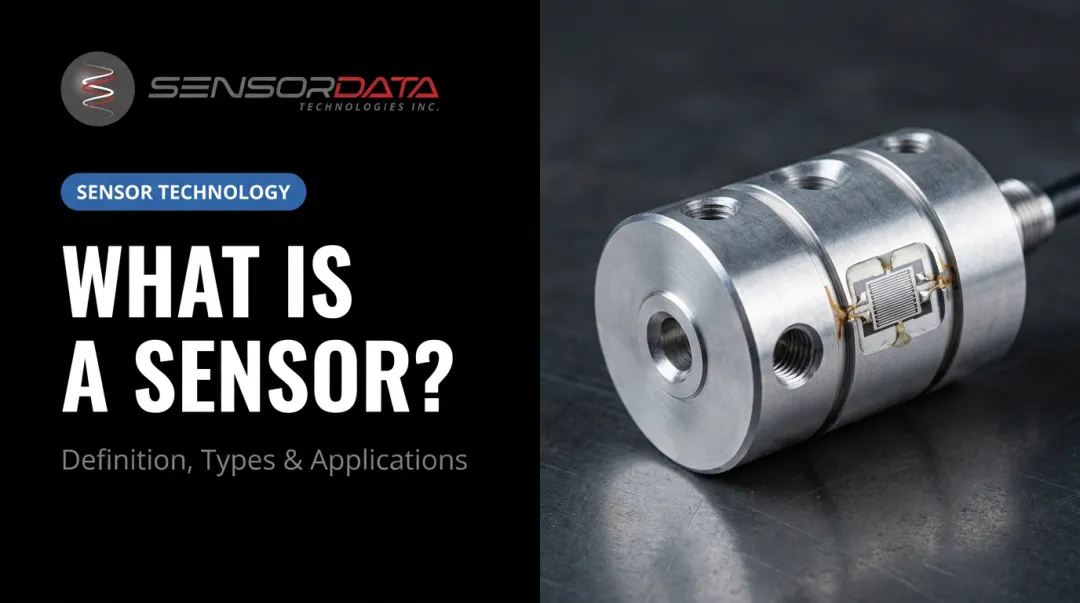
- Strain gauges detect surface deformation on test structures — bridge piers, aircraft wings, automotive chassis — by changing resistance as the material flexes
- Pressure sensors monitor hydraulic system behavior in real time
- Force-sensitive resistors provide go/no-go quality checks in assembly line applications
When evaluating sensing elements, three performance parameters drive most specification decisions:
- Sensitivity — the smallest detectable change in the physical quantity
- Linearity — how consistently the output tracks the input across the full measurement range
- Signal-to-noise ratio — critical in electrically noisy industrial environments where low-level signals are easily corrupted
Verifying these parameters before connecting a live sensor is where purpose-built tooling earns its place. SensorData Technologies' Model i100 Strain Gage Bridge Simulator lets engineers validate and calibrate the full signal conditioning chain in advance — catching setup errors before they become measurement errors in the field.
What Is a Transducer?
The VIM defines a measuring transducer as "a device, used in measurement, that provides an output quantity having a specified relation to the input quantity." That definition is broader than most people expect.
Transducers fall into two categories:
- Input transducers (sensors): Convert a physical stimulus into an electrical signal (force into mV/V, position into voltage, temperature into current)
- Output transducers (actuators): Convert an electrical signal into physical action (a motor converting current into rotation, a speaker converting voltage into sound)
This is why a loudspeaker is a transducer but not a sensor. Direction matters.
The "Sensor Within a Transducer" Concept
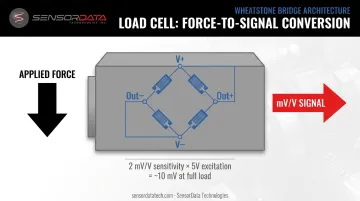
A load cell is the clearest industrial example of this architecture. The load cell as a whole is a transducer : it accepts mechanical force as input and delivers a calibrated electrical signal (typically in mV/V) as output. Internally, it contains strain gauges arranged in a Wheatstone bridge configuration as the actual sensing elements.
FUTEK describes this directly: strain-gauge load cells convert mechanical force into an electrical signal using strain gauges in a Wheatstone bridge configuration. The bridge produces an output in millivolts per volt — a 2 mV/V sensor with 5V excitation produces roughly 10 mV at full load. That's a low-level signal, which is why amplification is always the next step in the signal chain.
SensorData Technologies builds its force and torque transducers on this same architecture: fatigue-rated structural bodies with strain gauge bridges inside, engineered for demanding industrial cycles. The F140/F141/F142 series pancake load cells, for instance, are rated to 1 million pounds capacity and built for repetitive aerospace and automotive structural loading.
Industrial Transducer Applications
Complete transducer assemblies are essential wherever the full signal chain — sense, convert, output — must be self-contained and reliable:
- Torque transducers in automotive powertrain testing (SensorData's T258 and T259 rotary sensors have been used in high-speed GM and Ferrari motor characterization at up to 50,000 rpm)
- Force transducers in aerospace structural testing, including fatigue validation of airframe components under millions of load cycles
- Load cells in tire manufacturing — SensorData supplies Bridgestone Americas and Goodyear with fatigue-rated shear web load cells designed for continuous press cycling
- Military-spec torque sensors for component lifecycle testing (SensorData holds sole-source supplier status for the US Military on the T259 model, which meets AND 20002 and AND 10262 standards)
The global force sensor market was valued at $2.30 billion in 2024 and is projected to reach $3.93 billion by 2035 — reflecting consistent demand across these industries.
Key Differences That Matter in Practice
In practice, the sensor/transducer distinction shows up in three concrete ways: how products are labeled, what signal they output, and what conditioning they need before a DAQ can use them.
Terminology Overlap
When a datasheet says "force sensor," it may mean a bare strain gauge — or it may mean a complete load cell assembly. FUTEK's documentation describes load cells as "also known as force transducers," with both terms used for the same complete device. HBK lists force sensors, load cells, and transducers within a single product portfolio. The label alone doesn't tell you what you're getting.
The practical fix: read past the product name to the signal output specification. If it lists mV/V or 4-20mA, you're looking at a complete transducer. If it lists resistance in ohms and requires bridge excitation from your own circuit, you're looking at a sensing element.
Output Signal Differences
- Bare sensing elements output changes in resistance, capacitance, or raw voltage — useful if you're building your own conditioning circuit
- Complete transducers output a specified signal in a defined format: mV/V, ±10 VDC, 4-20mA, or digital/wireless
SensorData's T171-231 Dual Range Reaction Torque Sensor, for example, delivers ±10 VDC at 1 kHz bandwidth — plug it into a DAQ input and you have a measurement. A bare strain gauge requires the bridge, excitation supply, amplifier, and filter before you get anything usable.
That gap between raw output and usable measurement is exactly what signal conditioning closes.
The Signal Conditioning Gap
Most strain-gauge-based transducers output less than 10 mV/V at full scale. That's a small signal. NI's documentation on signal amplification states that bridge signal conditioners almost always include amplifiers to boost signal level, improve resolution, and increase signal-to-noise ratio.
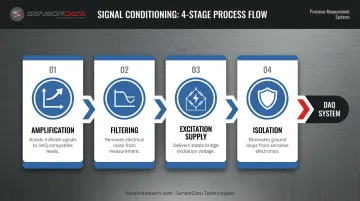
Signal conditioning covers:
- Amplifies millivolt signals to DAQ-compatible voltage levels
- Filters electrical noise out of the measurement
- Supplies the stable excitation voltage the bridge requires
- Isolates sensitive electronics from ground loops
SensorData's AC Strain Gage Conditioner Model I200 handles this for their rotary torque sensor line, providing two independent 5 VDC analog outputs with optional 4-20mA current loop output — connecting raw transducer output directly to a data acquisition system without external circuitry.
Which One Should You Choose?
The decision comes down to where you sit in the signal chain.
Choose a bare sensing element when:
- You're designing a custom circuit and need to integrate detection into your own board
- You have existing signal conditioning infrastructure
- You're replacing a failed sensing element within a known assembly
Choose a complete transducer assembly when:
- Your DAQ system needs a specific signal format (mV/V, 4-20mA, ±10V, digital)
- You need a self-contained, calibrated measurement device
- Environmental requirements — fatigue rating, temperature range, IP rating — are part of the specification
Application-based decision criteria:
| Factor | Consider |
|---|---|
| Output compatibility | Does your DAQ accept mV/V, 4-20mA, or digital input? |
| Load environment | Is this static or cyclic loading? Fatigue-rated or standard? |
| Precision requirements | Research-grade accuracy or industrial process monitoring? |
| Integration complexity | Do you have signal conditioning, or do you need it included? |
If a device delivers the right output signal and meets your accuracy and durability requirements, the label matters less than the fit.
For demanding applications — military lifecycle testing, aerospace structural fatigue, automotive powertrain validation — the specification detail matters. Wrong transducer selection can produce completely wrong measurement results, not just imprecise ones.
That's where working with an experienced manufacturer, rather than selecting from a catalog alone, makes a real difference. SensorData Technologies provides engineering consultation for exactly these scenarios, drawing on 30+ years of design experience in fatigue-rated force and torque measurement.
Conclusion
Sensors detect and measure; transducers convert energy between forms. Since sensors are a subset of transducers, the terms overlap — in meaning and in everyday industrial usage. The distinction matters at the system specification level, where understanding what signal your device produces and what your downstream system requires determines whether your measurement works.
For force, torque, and load measurement — in automotive test labs, structural testing facilities, or military validation programs — the practical question is always the same: what physical quantity are you measuring, how is it being converted, and what signal does your data acquisition system need? Answer those three questions, and the terminology distinction becomes a specification decision — not an abstract one. SensorData Technologies has been manufacturing strain gauge sensors and transducers for exactly these applications since 1993, which means the right device for your measurement chain is usually a straightforward engineering conversation.
Frequently Asked Questions
What is a transducer sensor?
Transducer sensor is a common phrase that's technically imprecise but widely understood. It refers to a device that senses a physical quantity and converts it into an electrical signal — functionally describing an input transducer. Most people use the term to mean any measurement device that produces an electrical output from a physical stimulus.
How does a transducer sensor work?
The device detects a physical change (applied force, pressure, or temperature), which causes a measurable shift in the sensing element — such as resistance change in a strain gauge bridge. That change is amplified and output as a proportional electrical signal in a format such as mV/V, voltage, or current.
Can a sensor be a transducer?
Yes. All sensors function as input transducers because they convert a physical stimulus into an electrical signal. The reverse is not true — output transducers like motors and loudspeakers convert electrical signals into physical action and are not sensors.
What is the difference between a sensor, a transducer, and a transmitter?
A sensor detects the physical quantity; a transducer converts it to an electrical signal; a transmitter amplifies that signal to a standardized output — typically 4-20mA — for long-distance transmission to a control system. NI notes that 4-20mA current loops have been used since the 1950s for industrial process monitoring.
What are common examples of transducers in industrial applications?
The most widely used industrial transducers include:
- Load cells — convert force to mV/V
- Torque transducers — convert rotational force to an electrical signal
- Pressure transducers — convert pressure to voltage or current
- LVDTs — convert linear position to voltage
- Thermocouples — convert temperature to voltage via the Seebeck effect
How do I choose between a sensor and a transducer for my application?
Start with the output specification your DAQ system requires, then work backward. Key factors to evaluate: the required signal format (mV/V, voltage, current), whether you need a bare sensing element or a complete assembly, available signal conditioning, and your accuracy and environmental durability requirements.