Introduction
A single flawed sensor reading in an automotive powertrain test can invalidate months of R&D data. In surgical devices and military aircraft, the stakes are higher still. Sensor accuracy isn't a nice-to-have — it's the foundation every downstream decision rests on.
The numbers reflect this dependency. According to Mordor Intelligence, the global sensors market is valued at $269.43 billion in 2026 and is projected to reach $439.66 billion by 2031 — a 10.29% CAGR driven by Industry 4.0 adoption, Industrial IoT (IIoT) expansion, automotive electrification, and connected healthcare.
For engineers, R&D teams, and procurement specialists, this growth creates a real challenge. With hundreds of manufacturers competing across dozens of sensing technologies, identifying the right supplier for a specific application — whether force measurement, MEMS inertial sensing, or industrial proximity detection — requires more than a Google search.
This guide does the sorting work for you. Below you'll find 20 leading global sensor manufacturers profiled by specialization, along with a practical framework for evaluating suppliers across the dimensions that matter most: technology depth, customization capability, certifications, and application fit.
Key Takeaways
- The global sensor market will exceed $439B by 2031, fueled by IIoT, smart manufacturing, and automotive electrification
- Top manufacturers range from multinational conglomerates (Honeywell, Bosch, Siemens) to precision specialists (Sensirion, KELLER AG)
- Certifications, sensing technology fit, and fatigue ratings are better selection criteria than brand recognition alone
- Fatigue-rated specialists outperform generalist suppliers in high-cycle dynamic load applications
- Customization capability and post-sales support separate good suppliers from great ones
Overview of the Global Sensor Manufacturing Industry
Sensor manufacturers design, manufacture, and supply devices that convert physical phenomena — force, pressure, temperature, motion, humidity, proximity — into electrical or digital signals. These signals enable automation, monitoring, and process control across industrial sectors.
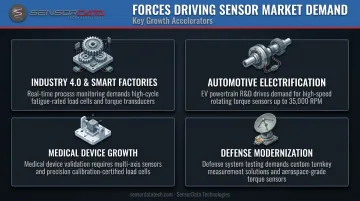
Several forces are accelerating market demand:
- Industry 4.0 and smart factories requiring dense sensor networks for real-time process data
- Automotive electrification demanding precise battery management, motor control, and torque measurement
- Medical device growth where miniaturized, highly accurate sensors support diagnostics and therapy
- Defense modernization programs requiring ruggedized sensors for mission-critical environments
The 20 manufacturers below fall into two distinct categories: diversified global players with broad sensor portfolios serving multiple industries, and precision specialists focusing on specific sensing technologies or verticals. Diversified players offer convenience and scale; precision specialists offer deeper expertise and tighter tolerances for demanding applications. Knowing which category fits your requirements will narrow this list quickly.
Top 20 Global Sensor Manufacturers
These manufacturers were selected based on global market presence, technological innovation, product breadth or specialization, industry certifications, and cross-sector applicability. Rankings are not hierarchical.
Honeywell International
Headquarters: Charlotte, NC, USA
Honeywell's sensor portfolio spans pressure, temperature, gas detection, force, humidity, and motion — serving aerospace, oil and gas, industrial automation, HVAC, and safety systems. The company supplies more than 300 gas-sensor products detecting 28 different gases.
Standout capability: Sensing solutions engineered for extreme environments — high pressure, corrosive atmospheres, wide temperature ranges — backed by global compliance certifications and decades of engineering heritage across defense and industrial markets.
Bosch Sensortec
Headquarters: Reutlingen, Germany
A Bosch Group subsidiary, Bosch Sensortec develops MEMS-based sensors including accelerometers, gyroscopes, magnetometers, barometric pressure sensors, and environmental gas sensors for automotive safety systems, smartphones, wearables, and IoT devices. The company produces more than 4 million MEMS sensors per day.
Standout capability: Industry-leading MEMS miniaturization that achieves high accuracy and ultra-low power consumption — two requirements that matter most for battery-powered consumer devices and automotive stability systems.
TE Connectivity
Headquarters: Galway, Ireland (formerly Tyco Electronics)
TE Connectivity offers one of the broadest sensor portfolios in the industry — pressure, temperature, force, position, speed, flow, vibration, and humidity sensors — serving transportation, industrial, medical, and communications markets in approximately 130 countries. Transportation Solutions sensor revenue reached $911 million in fiscal 2025.
Standout capability: Miniaturization expertise, extensive custom sensor integration support, and a global distribution network enabling rapid delivery across major markets worldwide.
Siemens
Headquarters: Munich, Germany
Siemens provides pressure transmitters, level sensors, and flow sensors — including the SITRANS P320/P420 series measuring gauge, absolute, and differential pressure — alongside its broader process instrumentation portfolio. Its Insights Hub platform (evolved from MindSphere) connects sensor data to cloud analytics and AI-driven manufacturing intelligence.
Standout capability: Ecosystem integration — Siemens sensors operate natively within its PLC, SCADA, and cloud analytics platforms, making it the preferred choice for large-scale Industry 4.0 deployments requiring seamless hardware-to-software connectivity.
Texas Instruments
Headquarters: Dallas, TX, USA
Texas Instruments produces analog and embedded semiconductor sensor ICs — including temperature, humidity, magnetic, mmWave radar, and optical sensors — serving automotive, industrial, consumer electronics, and communications markets.
Standout capability: Signal conditioning expertise with on-chip amplification, filtering, and digitization, plus a developer-friendly ecosystem with evaluation modules and software libraries that accelerate sensor system design.
STMicroelectronics
Headquarters: Geneva, Switzerland
STMicroelectronics manufactures MEMS inertial sensors, environmental sensors, and proximity sensors for smartphones, automotive safety systems, and industrial automation. Its MEMS product line includes accelerometers, gyroscopes, e-compasses, pressure sensors, biosensors, and MEMS microphones.
Standout capability: Energy-efficient consumer and automotive MEMS sensing, with an open-source developer ecosystem enabling faster prototyping and reduced time-to-market for sensor-based products.
Infineon Technologies
Headquarters: Neubiberg, Germany
Infineon's XENSIV sensor portfolio includes magnetic, current, pressure, gas, radar, MEMS microphone, and time-of-flight 3D sensors for automotive, industrial, and consumer applications. The company's ISO 26262 process compliance is certified by SGS-TÜV Saar for functional safety.
Standout capability: Dominant automotive sensor supplier with proven functional safety expertise (ISO 26262 compliant); growing presence in smart home, industrial IoT, and renewable energy sensing.
NXP Semiconductors
Headquarters: Eindhoven, Netherlands
NXP focuses on automotive and secure industrial semiconductor sensing — accelerometers, gyroscopes, magneto-resistive sensors, and pressure sensors used in wheel-speed detection and vehicle safety systems. Its AMR-based magnetic sensors deliver precise wheel-speed measurement for automotive applications.
Standout capability: Integrated security architecture combining sensing with on-chip authentication, making NXP sensors ideal for automotive and access-control applications where data integrity cannot be compromised.
Omron Corporation
Headquarters: Kyoto, Japan
Omron develops photoelectric, inductive proximity, and industrial automation sensors alongside healthcare sensors for blood pressure and pulse monitoring. Its healthcare division has sold more than 400 million home-use blood pressure monitors globally.
Standout capability: System-level integration — pairing sensors with controllers and actuators for complete automation solutions — combined with a dominant position in medical-grade home monitoring devices.
Analog Devices, Inc.
Headquarters: Wilmington, MA, USA
Analog Devices (ADI) leads in high-performance analog signal chain technologies, offering MEMS accelerometers, gyroscopes, inertial measurement units, and industrial sensor solutions for precision measurement. Its MEMS portfolio also extends to microphones and specialized IMUs for defense and aerospace applications.
Standout capability: Precision data converters and sensor conditioning ICs enabling high-fidelity measurements in autonomous vehicles, medical imaging, and structural health monitoring applications.
SICK AG
Headquarters: Waldkirch, Germany (founded 1946)
SICK AG develops intelligent photoelectric, proximity, safety, barcode, and vision sensors for factory automation, logistics, transportation, and process industries. The company operates in around 40 countries with 50 subsidiaries, reporting €1.74 billion in 2024 revenue.
Standout capability: Proven application expertise in industrial safety sensing and logistics automation — SICK safety light curtains and laser scanners are widely specified for CE-compliant machine guarding in manufacturing facilities.
KEYENCE Corporation
Headquarters: Osaka, Japan (founded 1974)
KEYENCE is recognized for high-precision fiber optic sensors, laser displacement sensors, and vision systems for demanding factory automation, quality inspection, and dimensional measurement. The company serves 350,000 clients across 250 offices in 46 countries with $7.0 billion in annual sales.
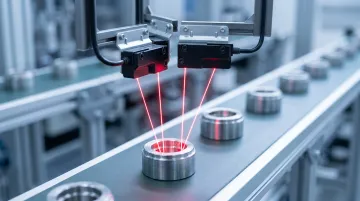
Standout capability: A direct sales model staffed by highly trained application engineers, with products positioned at the high-performance end of the industrial sensing market — commanding a reputation for measurement accuracy that justifies premium pricing.
Pepperl+Fuchs
Headquarters: Mannheim, Germany (founded 1945)
Credited with developing the first industrial inductive proximity sensor (1958), Pepperl+Fuchs produces inductive, photoelectric, ultrasonic, capacitive, LiDAR, radar, and vibration monitoring sensors for global industrial automation markets. ATEX/IECEx certifications are available across its sensor range.
Standout capability: The primary choice for hazardous area applications — its ATEX- and IECEx-certified sensors are widely deployed in chemical plants, oil refineries, and explosive environments where intrinsic safety is non-negotiable.
Baumer Group
Headquarters: Frauenfeld, Switzerland (founded 1952)
Baumer supplies high-quality sensors for factory and process automation — including inductive proximity, photoelectric, pressure, and temperature sensors — with strong penetration in food and beverage, pharmaceutical, and precision engineering sectors.
Standout capability: Robust construction standards — IP67/IP69K ratings, stainless steel housings, and hygienic design variants — specifically engineered for industries with stringent cleanliness and washdown durability requirements.
Amphenol Corporation
Headquarters: Wallingford, Connecticut, USA
Amphenol is one of the world's largest providers of high-technology interconnect, sensor, and antenna solutions — offering gas, moisture, level, position, pressure, temperature, and vibration sensors serving aerospace, automotive, defense, and industrial markets.
Standout capability: Draws on interconnect manufacturing expertise to deliver sensor assemblies with reliable electrical interfaces, serving defense and aerospace customers requiring MIL-SPEC certified connectors and rugged form factors.
First Sensor AG
Headquarters: Berlin, Germany (founded 1991; now part of TE Connectivity)
First Sensor specializes in optical, pressure, and photonic sensor solutions — from chip-level components to complete OEM sensor systems — for medical technology, industrial automation, and mobility markets. TE Connectivity acquired a majority share in March 2020.
Standout capability: Custom sensor design capability spanning chip-to-system integration, with particular strength in regulatory-compliant medical pressure and flow sensors where precise calibration and biocompatibility requirements apply.
Murata Manufacturing
Headquarters: Nagaokakyo, Kyoto, Japan
Murata produces ceramic-based electronic components and sensors including piezoelectric sensors, thermistors, ultrasonic sensors, accelerometers, gyroscopes, CO2 sensors, and AMR magnetic sensors for automotive, industrial, and consumer electronics applications.
Standout capability: Proprietary ceramic materials technology and wireless sensing integration — compact sensor modules with built-in wireless connectivity widely used in automotive safety and industrial condition monitoring.
Rockwell Automation
Headquarters: Milwaukee, Wisconsin, USA
Rockwell Automation offers inductive, photoelectric, ultrasonic, and safety sensors as part of its Allen-Bradley platform for manufacturing process control. Sensors align with Logix architectures and integrate with FactoryTalk software for unified data management.
Standout capability: Native integration with the Allen-Bradley automation ecosystem — Rockwell sensors are the preferred choice for facilities standardized on its PLC and software architecture seeking unified hardware-to-software performance.
Sensirion AG
Headquarters: Stäfa, Switzerland (founded 1998, ETH Zurich spin-off)
Sensirion specializes in environmental and liquid flow sensors measuring humidity, temperature, VOC, CO2, PM2.5, gas flow, and differential pressure. Its proprietary CMOSens technology fuses sensor structures and evaluation electronics on a single CMOS chip, enabling factory-calibrated precision at scale.
Standout capability: Liquid flow sensors widely specified in respiratory therapy devices, drug delivery systems, and HVAC optimization — with documented applications in subcutaneous drug delivery for pharmaceutical manufacturers.
KELLER AG
Headquarters: Winterthur, Switzerland (founded 1974)
KELLER AG is a precision manufacturer of piezoresistive pressure sensors and transmitters for industrial, hydraulic, and environmental monitoring applications. The company was established by Hannes W. Keller and celebrated its 50th anniversary in 2024.
Standout capability: Tight measurement tolerances, submersible-rated designs, and OEM customization capability — sensors deployed in groundwater monitoring, hydraulic test systems, and process control environments where measurement precision directly impacts operational safety.
How We Chose These Top 20 Sensor Manufacturers
Selection Criteria
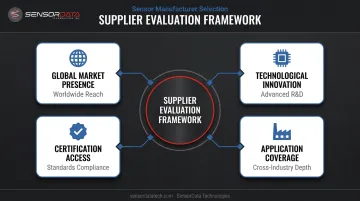
Each manufacturer was evaluated against four core criteria:
- Global market presence — revenue scale and geographic reach
- Technological innovation — demonstrated advancement in MEMS, piezoelectric, semiconductor, or mechanical sensing
- Application coverage — breadth across key industrial verticals
- Certification access — ISO 9001, ATEX/IECEx, AEC-Q100, MIL-SPEC, ISO 13485, or FDA compliance relevant to target industries
The Mistake Most Buyers Make
These four criteria exist because procurement teams routinely skip them. The most common error is selecting a manufacturer by brand recognition alone — without checking whether the sensor technology, accuracy class, and certifications actually fit the application. Process industry research identifies selecting the wrong sensor type as one of the most frequent and costly instrumentation errors.
Why Specialization Matters for Demanding Applications
The list intentionally balances diversified global players with precision specialists. For most standard automation or consumer applications, a broad-portfolio manufacturer delivers adequate performance at competitive cost.
For force and torque measurement in high-cycle dynamic environments — powertrain testing, structural fatigue labs, aerospace validation, military load monitoring — the requirements become far more specific. Generalist suppliers rarely offer:
- Fatigue-rated designs with documented cycle life guarantees
- Custom engineering to specific form factor, measurement range, or output requirements
- Responsive post-sales support for application-specific troubleshooting
As Interface Force notes, fatigue-rated load cells are specifically designed for high-cycle repeated loading. Insufficient capacity in these applications doesn't just degrade performance — it causes mechanical failure.
Conclusion
The global sensor manufacturing landscape is diverse by design. Large multinationals like Honeywell, Bosch, and Siemens offer breadth across dozens of sensor types and well-established supply chains. Precision specialists deliver the application depth, custom engineering capability, and fatigue-rated performance that demanding measurement environments require. No single manufacturer is the right choice for every application.
Before finalizing any supplier relationship, go beyond the marketing materials:
- Verify certifications against your specific application requirements (ATEX, MIL-SPEC, ISO 13485)
- Request fatigue life data for any dynamic load application
- Confirm custom design capabilities and the engagement process
- Assess warranty terms, return policies, and delivery reliability records
For precision force and torque measurement — fatigue-rated load cells, multi-axis transducers, high-speed rotating torque sensors, and custom-engineered force measurement systems for automotive testing, aerospace validation, military programs, and structural labs — SensorData Technologies offers 30+ years of specialized expertise from its Shelby Township, Michigan facility.
Key credentials for high-stakes procurement decisions:
- 100% satisfaction guarantee on all standard sensors
- Fatigue-rated load cells engineered for extreme cycle demands
- High-speed rotating torque sensors rated to 35,000 RPM, field-proven in aircraft fuel pump test stands
- Customer roster including Ford, Goodyear, Bridgestone, and Parker Hannifin
- Sole-source provider of the T259 Military Spec Dual Range Torque Sensor for the U.S. Military
Contact SensorData Technologies to discuss your application-specific requirements.
Frequently Asked Questions
What is the most used sensor?
Temperature sensors hold the largest share of the global sensors market — approximately 22-23% according to Mordor Intelligence — due to their universal applicability across HVAC, automotive engine management, industrial process control, consumer electronics, and medical monitoring. Pressure sensors and proximity sensors follow closely in industrial and automotive contexts.
What types of sensors do the top global manufacturers specialize in?
Specializations vary widely. MEMS-focused manufacturers (Bosch Sensortec, STMicroelectronics) lead in inertial and environmental sensing. Industrial automation specialists (SICK, Pepperl+Fuchs, Omron) focus on proximity and photoelectric sensing, while precision specialists cover force, torque, pressure, and flow measurement for high-accuracy industrial and testing applications.
How do I choose the right sensor manufacturer for my application?
Start by matching the manufacturer's core sensing technology to the physical quantity you're measuring, then verify application-relevant certifications — ATEX for hazardous areas, MIL-SPEC for defense, ISO 13485 for medical. Confirm custom design availability and evaluate warranty terms and delivery reliability before committing to a supplier.
What certifications should I look for when evaluating a sensor manufacturer?
Key certifications by industry:
- ISO 9001 — quality management baseline (universal)
- ATEX/IECEx — hazardous area sensors
- AEC-Q100 — automotive-grade components
- MIL-SPEC/MIL-STD — military and defense applications
- ISO 13485 / FDA compliance — medical-grade sensing devices
What is the difference between a sensor and a transducer?
A transducer converts one form of energy to another — mechanical force into an electrical signal, for example — while a sensor detects and responds to a specific physical input from its environment. In practice, most precision sensing devices, including load cells and pressure transmitters, function as both. The terms are often used interchangeably in industry.