This article breaks down the fundamental differences between passive and active sensors, explains where each technology excels, and provides a practical framework for selecting the right approach based on your actual measurement requirements.
Key Takeaways
- Passive sensors convert ambient energy into a signal without needing external power.
- Active sensors generate their own excitation signal to produce a measurement.
- Active sensors deliver higher accuracy and stronger output signals, making them better suited for harsh industrial environments.
- Passive sensors are simpler, lower cost, and well-suited for remote or low-power deployments.
- Neither type is universally superior — application requirements should always drive the selection.
- Many industrial measurement systems combine both sensor types to meet competing demands for precision and power efficiency.
Passive vs. Active Sensors: Quick Comparison
Choosing between passive and active sensing comes down to your measurement environment and required accuracy. The table below maps the key differences across the attributes that matter most in industrial applications.
| Attribute | Passive Sensors | Active Sensors |
|---|---|---|
| Power Requirement | No external power needed; draw energy from the measured phenomenon | Require dedicated external power supply |
| Signal Output | Low-level analog signals; may need external amplification | Conditioned output with higher fidelity and noise immunity |
| Accuracy & Resolution | Sufficient for moderate-accuracy applications | Higher resolution; suited for tight-tolerance measurement |
| Environmental Suitability | Best in controlled, low-interference environments | Engineered for high vibration, extreme temperatures, and EMI |
| Cost & Complexity | Lower unit cost; simpler wiring | Higher unit cost; more integration complexity |
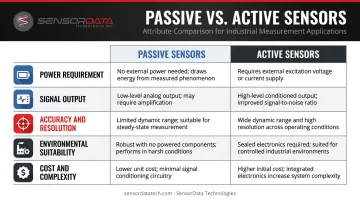
The decision hinges on application demands. A passive sensor may be perfectly adequate for a static load monitoring setup in a controlled lab. On a rotating powertrain test rig — dealing with high-frequency vibration, electrical noise, and tight torque resolution requirements — active sensing is the practical choice.
What Are Passive Sensors?
A passive sensor detects energy that already exists in the environment — heat, light, mechanical displacement, natural radiation — and converts it into a readable output without emitting any energy of its own.
The sensor element responds to a physical change and produces a proportional signal, typically a voltage or resistance shift, which external instrumentation reads as a measurable signal. The phenomenon itself is the source — no excitation required.
Common Types of Passive Sensors
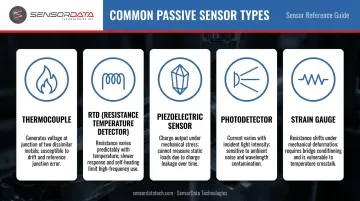
Key passive sensor types relevant to industrial and force/torque measurement contexts include:
- Thermocouples — Operate via the Seebeck effect: two dissimilar metals joined at a junction generate a thermoelectric voltage proportional to temperature. According to Omega Engineering, thermocouples cover wide temperature ranges (-210°C to 1760°C) but are generally less accurate and stable than RTDs.
- RTDs (Resistance Temperature Detectors) — Resistance changes predictably with temperature; platinum RTDs offer better linearity than thermocouples but have a narrower range (-240°C to 650°C) and are susceptible to self-heating errors.
- Piezoelectric sensors (charge-output mode) — Generate electrical charge proportional to applied force. HBK notes these have a typical linearity error of 0.5% relative to full scale and estimated drift of 1 N/min — less stable than strain gauge transducers for static measurements.
- Photodetectors — Convert incident light into electrical current without emitting light themselves.
- Strain gauge elements (unconditioned) — The resistive element changes resistance under strain; the bare element is passive, though measuring it requires excitation.
These characteristics translate into practical advantages for field and industrial use:
- No power infrastructure required at the measurement point
- Simpler wiring and lower installation cost
- No risk of introducing electromagnetic interference from the sensor itself
- Suited for battery-limited or remote installations
Where Passive Sensors Fit
Passive sensing dominates in applications where power availability is the constraint, not measurement precision:
- Environmental monitoring in remote field locations
- Temperature sensing in process control (thermocouples, RTDs)
- Basic structural health monitoring in civil infrastructure
- Geotechnical monitoring with embedded sensors in composite or concrete structures
- Seismic detection in petroleum and mining operations
What Are Active Sensors?
An active sensor generates its own energy signal, emits it, and then measures the returned or altered signal to derive a measurement. Unlike passive sensors, which rely on external energy sources, an active sensor controls both the stimulus and the detection.
In industrial force and torque measurement, this means applying an excitation voltage or current to a sensing element — such as a Wheatstone bridge in a load cell — and measuring the output signal proportional to the applied physical load.
National Instruments explains that applied force changes the resistance of strain gauges in the bridge, and the resulting voltage output is proportional to that force.
Common Types of Active Sensors
Active sensor types relevant to industrial measurement include:
- Strain gauge load cells — Full Wheatstone bridge configurations with four active strain gauges; output voltage proportional to applied force
- Force transducers — Bridge-based sensing elements for static and dynamic force measurement
- Torque sensors — Slip ring, rotary transformer, magnetic, and wireless configurations for rotating shaft measurement
- Hall effect sensors — Generate a Hall voltage when current flows through a conductor in a magnetic field; used for position, speed, and current sensing
- Accelerometers — Measure acceleration by detecting inertial forces on a sensing element
- Inductive proximity sensors — Emit an oscillating electromagnetic field; metallic targets alter the field, producing a detection signal
- Ultrasonic transducers — Emit acoustic pulses and measure return time or altered signal
- LiDAR and RADAR — Active remote sensing instruments that emit laser pulses or radio waves and measure the returned signal
Active Sensor Output Configurations
Integration level determines how much external signal conditioning your system requires. Three configurations cover most industrial applications:
- Bridge-output sensors (unamplified) — Raw mV/V output requiring external signal conditioning; maximum flexibility for integration with existing DAQ systems
- Amplified/conditioned sensors — On-board electronics producing ±10V, 4-20mA, or digital outputs; reduce external hardware requirements
- Wireless active sensors — Onboard amplification and analog-to-digital conversion with wireless transmission; eliminate cabling constraints entirely
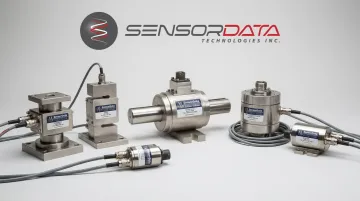
SensorData Technologies' BT4000 wireless torque sensor, for example, performs on-board 16-bit digital conversion and transmits via 2.4 GHz Bluetooth to distances up to 100 feet — with full immunity to EMI and ground loop interference. Their SYNTH wireless platform extends that range to over 500 feet and is rated for use in ZONE1 DIV 1 explosive environments, making it viable for oil drilling, aerospace testing, and EV powertrain applications where cabling is either impossible or hazardous.
Where Active Sensors Dominate
Active sensing is the standard in any application where measurement precision, dynamic response, or environmental robustness is non-negotiable:
- Fatigue and life cycle testing of automotive and aerospace components
- Drivetrain torque measurement in vehicle development
- Structural load monitoring in test laboratories
- Force feedback in robotic and automated assembly systems
- Military and defense platform load monitoring
- Medical device force-controlled testing
The market reflects this prevalence. According to MarketsandMarkets, the global force sensor market was valued at $2.30 billion in 2024 and is projected to reach $3.93 billion by 2035, driven by growth in industrial automation, robotics, and advanced manufacturing.
SensorData Technologies builds its force and torque sensor portfolio on active Wheatstone bridge principles. That includes fatigue-rated load cells guaranteed for 100 million fully reversed cycles, high-speed rotary torque sensors rated to 35,000 RPM, and multi-axis sensors for complex load state measurement in structural test laboratories.
Which Sensor Type Is Right for Your Application?
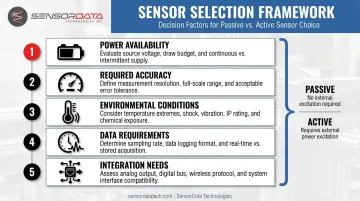
Selecting between passive and active sensing comes down to five concrete factors:
- Power availability — Is external power accessible at the measurement point?
- Required accuracy — Does the application demand tight tolerances and repeatable output?
- Environmental conditions — What temperature range, vibration levels, and EMI exposure will the sensor face?
- Data requirements — Is real-time dynamic measurement needed, or is periodic sampling acceptable?
- Integration — Does the sensor need to interface with existing DAQ systems, digital control loops, or wireless networks?
Decision Framework
Choose passive sensors when:
- Power infrastructure is unavailable or cost-prohibitive at the measurement location
- The application tolerates moderate accuracy (temperature monitoring, basic load indication)
- Simplicity of installation is the priority
- The measurement environment is controlled and low-interference
Choose active sensors when:
- Measurement precision and repeatability are non-negotiable
- The environment involves high vibration, extreme temperatures, or EMI
- Dynamic measurements are required (fatigue cycling, high-frequency force events)
- Digital integration with control systems or DAQ platforms is needed
- Wireless or cable-free transmission is required
Hybrid Systems: Using Both Together
Some measurement setups benefit from combining sensor types. A load cell measuring force (active) may be paired with passive temperature-compensation components to correct for thermal drift. A load cell measuring force (active) may be paired with passive temperature-compensation components to correct for thermal drift. These include fixed span resistors or temperature-sensitive wire added to the excitation legs of the Wheatstone bridge. Omega Engineering's strain gauge instrumentation guide documents this as a practical method for improving accuracy in variable-temperature environments.
Application-Specific Guidance
| Application | Sensor Type | Key Reason |
|---|---|---|
| Automotive fatigue and life cycle testing | Active force transducers | Dynamic response and high-cycle accuracy |
| Structural test laboratory (multi-load states) | Multi-axis active sensors | Captures complex combined loads |
| Remote environmental or geotechnical monitoring | Passive or low-power sensors | No power infrastructure required |
| EV powertrain testing in confined spaces | Wireless active torque sensors | Cable-free, EMI-immune operation |
| Explosive or hazardous zone measurement | Wireless active sensors (ZONE 1 / DIV 1) | Intrinsically safe certification required |
For applications where test data reliability determines whether a component passes or fails — automotive proving grounds, aerospace structural labs, military platform testing — sensor selection directly affects the validity of every downstream engineering decision. SensorData Technologies designs and manufactures fatigue-rated load cells, rotary torque sensors, and multi-axis transducers for exactly these environments, with in-house engineering consultation and calibration services to fit the sensor to the test.
Conclusion
Passive and active sensors each occupy a defined role in industrial measurement. Passive sensors belong in applications where low cost, simplicity, and power independence matter more than precision. Active sensors are the technology of choice when measurement accuracy, environmental robustness, and system integration are the priority — which describes most serious industrial testing environments.
The right choice comes down to what the application actually demands. Four factors drive that decision:
- The measurement environment (temperature, vibration, EMI exposure)
- Required accuracy and signal conditioning complexity
- Available power infrastructure at the measurement point
- How the data will be used downstream
Getting this selection right protects test data integrity, reduces calibration burden, and keeps the engineering decisions built on that data defensible.
Frequently Asked Questions
What is the difference between active and passive sensors?
Passive sensors detect naturally occurring energy — heat, light, mechanical force — without requiring external power, converting it directly into a readable output. Active sensors generate and emit their own excitation signal and require a power source to operate.
What are the advantages of active sensors over passive sensors?
Active sensors deliver higher measurement accuracy and resolution, perform reliably in harsh conditions including high vibration, extreme temperatures, and EMI-rich environments, and integrate directly with modern digital data acquisition systems. They also support real-time dynamic measurements with stronger, noise-resistant output signals.
Is LiDAR an active or passive sensor?
LiDAR is an active sensor. As NASA ARSET confirms, it transmits its own laser pulses and measures the time it takes for those pulses to reflect back from objects — it does not rely on ambient light or naturally occurring energy.
Can active and passive sensors be used together in the same system?
Yes, hybrid systems are common. An active load cell measuring force can be paired with passive temperature-compensation components, such as fixed span resistors in the bridge excitation circuit. These correct for thermal drift and improve overall measurement accuracy in variable-temperature industrial environments.
Which sensor type is better for harsh industrial environments?
Active sensors are generally preferred in harsh environments because they produce stronger, conditioned output signals that resist noise, temperature extremes, and mechanical vibration. Sensor selection should still be validated against the specific environmental specifications of the application.
What are examples of passive sensors in industrial applications?
Common examples include thermocouples, RTDs, piezoelectric elements operating in charge-output mode, and photodetectors. These are typically used in temperature monitoring, basic structural health sensing, and remote deployments where external power is unavailable.