This article covers what sensors are, how they work, how they're classified, the most common types, and where they matter most in demanding industrial environments.
Key Takeaways
- A sensor detects a physical change and converts it into a measurable electrical signal
- Sensors are classified by power requirement, output type, and the physical quantity they measure
- Core industrial types include temperature, pressure, force/load, proximity, motion, and chemical sensors
- Force and load sensors (load cells, strain gauges, torque sensors) are critical in automotive, aerospace, medical, and materials testing
- Choosing the right sensor means matching range, accuracy, environmental rating, and fatigue rating to your application
What Is a Sensor? Definition and Core Concepts
NIST defines a sensor as "a transducer that converts a physical, biological or chemical parameter into an electrical signal." In plain terms: a sensor detects something happening in the physical world — heat, force, pressure, motion, chemical concentration — and produces an electrical output that a system can read, record, or respond to.
Sensor vs. Transducer
The two terms are related but not interchangeable. All sensors are transducers, but not all transducers are sensors. A transducer converts energy from one form to another — a solenoid valve converting electrical signals into mechanical movement is a transducer. A load cell measuring force on a press is functioning as a sensor. The key difference is measurement intent: sensors detect and quantify physical quantities; transducers are the broader category that includes actuators and other energy-converting devices.
Where Sensors Fit in a System
Sensors are the first link in a data acquisition or control chain. The signal they produce feeds into:
- Signal conditioners that amplify, filter, and linearize the raw output
- Analog-to-digital converters that translate continuous signals into digital data
- Software or controllers that log, display, or act on the processed data
This chain underpins industrial automation, IoT infrastructure, and smart manufacturing. Eurostat reported that 24% of EU enterprises used IoT sensors or tags for condition-based maintenance of machinery in 2021.
Key Performance Characteristics
When evaluating or selecting sensors, four parameters drive the decision:
- Sensitivity — smallest detectable change in the measured quantity
- Accuracy — closeness of the output to the true value
- Range — minimum to maximum measurable value
- Response time — how quickly the sensor reacts to a change
How Does a Sensor Work?
Every sensor converts a physical change into a usable electrical signal through three stages: sensing, transduction, and signal conditioning.
The Sensing Element
The sensing element directly contacts or responds to the physical property being measured. In a strain gauge, a thin conductive foil deforms when mechanical force is applied — changing its electrical resistance proportionally to the strain. In a thermocouple, two dissimilar metals joined at one end generate a voltage when that junction experiences a temperature change (the Seebeck effect).
Transduction and Raw Signal Output
The sensing element's response produces an initial electrical signal — typically a small voltage, resistance change, or current variation. This raw signal is usually weak, nonlinear, or noisy. Neither can be read directly by downstream instrumentation.
For strain gauge-based sensors, NI documents that four strain gauges arranged in a Wheatstone bridge configuration convert structural deformation into a differential voltage output. HBK confirms that a full-bridge circuit uses active gauges in all four arms, improving sensitivity and temperature compensation.
Signal Conditioning
Signal conditioning transforms the raw output into a clean, accurate, usable signal. This involves:
- Amplifies low-voltage signals to a readable range
- Filters out electrical noise that distorts measurements
- Linearizes nonlinear sensor responses for accurate output
- Supplies reference voltage or current that passive sensors require
Some sensors include built-in conditioning (often called "smart sensors"). Others rely on external conditioning hardware. For load cells and strain gauges, signal conditioners can convert bridge outputs into standard process signals such as 4–20 mA or 0–10 V for compatibility with PLCs and data acquisition systems.
Analog vs. Digital Output
- Analog sensors produce a continuous electrical signal proportional to the measured value — common in pressure transducers and load cells
- Digital sensors output discrete values or data streams — easier to interface with microcontrollers and modern data systems
Both have trade-offs. Analog signals offer high resolution but are susceptible to noise over long cable runs. Digital outputs have better noise immunity but introduce quantization limits.
How Are Sensors Classified?
Three classification frameworks matter most in practice.
By Power Requirement
Self-generating sensors produce an electrical output without external excitation — thermocouples and piezoelectric accelerometers are examples. Excitation-dependent sensors require an external power source to operate; strain gauges and RTDs fall into this category.
Note: The labels "active" and "passive" are used inconsistently across the industry. Some sources call thermocouples passive; others call strain gauges active. Rather than relying on the labels, focus on the practical question: does this sensor need an external excitation source to function?
By Output Type
| Output Type | Signal Format | Common Use |
|---|---|---|
| Analog | Continuous voltage or current (e.g., 0–10 V, 4–20 mA) | Load cells, pressure transducers |
| Digital | Discrete on/off or data stream | Proximity switches, smart sensors |
Many modern sensors integrate analog-to-digital conversion internally, which simplifies connection to microcontrollers and data acquisition systems.
By Measured Quantity
The most practical classification for engineers selecting sensors:
- Mechanical — force, pressure, displacement, torque
- Thermal — temperature
- Electromagnetic — light, magnetic field
- Chemical — gas concentration, humidity, pH
- Motion/inertial — acceleration, rotation rate
Common Types of Sensors
Temperature Sensors
Temperature sensors measure thermal energy and appear in nearly every industry. Three technologies dominate:
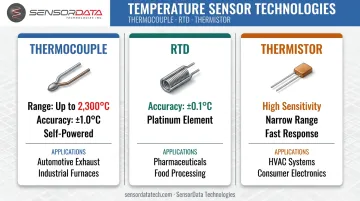
- Thermocouples — two dissimilar metals generate voltage proportional to temperature; wide range (up to approximately 2,300°C depending on type); typical accuracy of ±1.0°C; self-powered; common in automotive exhaust systems and industrial furnaces
- RTDs — resistance increases predictably with temperature; platinum is standard; accuracy around ±0.1°C in precision applications; used in pharmaceuticals and food processing
- Thermistors — high sensitivity over a narrow range; fast response; inexpensive; common in HVAC and consumer electronics
The temperature sensor market is projected to reach USD $8.94 billion by 2030, reflecting how broadly this sensor category is deployed.
Pressure Sensors
Pressure sensors measure the force a gas or liquid exerts on a surface — typically using a flexible diaphragm or piezoelectric element that deforms under load and produces a proportional electrical output.
Key applications:
- Tire pressure monitoring systems (TPMS) — direct systems place a sensor inside each tire, broadcasting real-time pressure to the vehicle's ECU
- Medical blood pressure monitoring — extravascular transducers measure pressure changes through mechanical or electrical property changes
- Hydraulic system monitoring — construction equipment, petroleum machinery, and industrial presses rely on pressure sensors to detect system faults and control force application
The pressure sensor market stands at USD $13.07 billion in 2025, projected to reach $17.70 billion by 2030 at a 6.2% CAGR.
Force, Load, and Torque Sensors
Force sensors measure mechanical forces — tension, compression, weight, and rotational force (torque). They are essential wherever structural integrity, product quality, or process control depends on knowing exactly how much force is being applied.
How strain gauge load cells work:
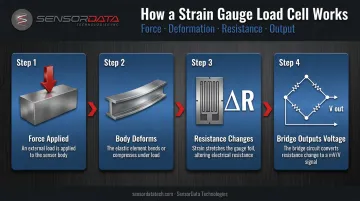
- Apply force to a machined metal structural body (beam, yoke, or ring)
- The body deforms slightly under load
- Strain gauges bonded to the body change electrical resistance in proportion to the deformation
- Four gauges arranged in a Wheatstone bridge configuration convert those resistance changes into a differential voltage output proportional to the applied force
These load cells appear across a wide range of industries where precise force data drives safety, compliance, or product quality:
- Brake pedal force and wheel force transducers in automotive testing
- Rocket engine thrust measurement — NIST confirms load cells are the standard method for this application
- Compression strength testing of concrete (per ASTM C39) and tensile testing of metals and composites
- Process control, batching, and inventory management in industrial weighing
Torque sensors extend this capability to rotating shafts and drivetrain components. Technologies include slip ring designs (continuous electrical contact for rotating shafts), rotary transformer designs (non-contact, preferred for high-speed or high-reliability applications), and wireless systems for environments where cable routing isn't practical.
For applications involving repetitive cyclic loading — fatigue testing, structural life-cycle studies, or continuous monitoring on test stands — standard sensors can fail prematurely. Fatigue-rated load cells are designed specifically for these conditions, built to withstand 100 million fully reversed cycles without failure. SensorData Technologies (Shelby Township, Michigan) has manufactured fatigue-rated load cells and multi-axis sensors since 1993, serving automotive, aerospace, defense, and materials testing customers.
Proximity and Position Sensors
Proximity sensors detect the presence or absence of an object without physical contact. The main technologies:
- Inductive — detects ferrous and non-ferrous metals via electromagnetic field disruption
- Capacitive — detects non-metallic targets including plastics, liquids, and powders
- Ultrasonic — uses sound waves; works on nearly any material
- Infrared — optical detection for short-range presence sensing
Position sensors track exact location or displacement. LVDTs (Linear Variable Differential Transformers) measure linear displacement with high accuracy and are common in aerospace actuation systems, valve position feedback, and fatigue test frames. Rotary encoders track angular position in servo motors and robotic joints.
Motion and Vibration Sensors
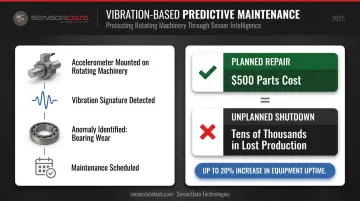
Accelerometers measure acceleration along one, two, or three axes. In industrial environments, they're mounted on rotating machinery to monitor vibration signatures — a shift in frequency or amplitude often signals bearing wear, imbalance, or structural loosening before a failure occurs.
Gyroscopes measure rotational rate and appear in navigation systems, drones, and vehicle stability control.
Predictive maintenance programs built on vibration sensor data can increase equipment uptime by up to 20%, according to Deloitte. Catching a failing bearing at $500 in parts is a far better outcome than an unplanned shutdown costing tens of thousands in lost production.
Chemical and Environmental Sensors
Chemical sensors detect specific gases, vapors, or concentrations in air or liquids:
- Oxygen sensors in automotive exhaust systems provide feedback to the engine control module, keeping the air/fuel ratio near the target value
- Multi-gas monitors in industrial facilities can simultaneously detect oxygen levels, combustible atmospheres, and multiple toxic gases in one handheld unit
- Humidity sensors in HVAC systems, agriculture, and pharmaceutical manufacturing monitor moisture levels that affect product quality or equipment performance
These sensors are critical for worker safety, regulatory compliance, and process quality control.
Key Industrial Applications of Sensors
The industrial sensors market was valued at USD $27.97 billion in 2024 and is projected to reach $42.1 billion by 2029. That growth reflects increasing automation, tightening quality standards, and the expansion of predictive maintenance programs across manufacturing sectors.
High-Stakes Industry Applications
| Industry | Sensor Applications |
|---|---|
| Automotive | Engine test stands, brake force measurement, wheel force transducers, powertrain dynamometers, EV motor testing |
| Aerospace | Rocket thrust measurement, structural load testing, vibration analysis, flight control actuation feedback |
| Medical | Patient monitoring, surgical instrument force feedback, implantable device testing, biomedical materials testing |
| Military/Defense | Vehicle systems testing, weapons platform instrumentation, military-spec torque sensors for drivetrain testing |
| Construction | Compressive strength testing of concrete, structural load monitoring, crane and lifting equipment load measurement |
| Power Generation | Wind turbine torque monitoring, generator shaft measurement, equipment health monitoring |
Sensor Selection for Industrial Environments
Each industry above demands different sensor characteristics — and the wrong choice can do more than skew your data. Selecting an undersized or poorly matched sensor for a given environment risks premature failure and, in high-load applications, genuine safety hazards. Key selection factors:
Each industry above demands different sensor characteristics, and the wrong choice can do more than skew your data. Selecting an undersized or poorly matched sensor risks premature failure and, in high-load applications, genuine safety hazards. Key selection factors:
- Measurement range — the sensor must cover the full range of expected values with margin
- Accuracy class — OIML R60 ranks load cells into classes A, B, C, and D based on performance
- Environmental protection — IEC 60529 IP ratings define resistance to dust and liquid ingress; outdoor or washdown environments demand higher IP ratings
- Operating temperature — sensor materials and electronics must perform across the full ambient range
- Fatigue rating — for cyclic load applications, a standard sensor will eventually crack at the stress concentration points; fatigue-rated designs account for this from the start
- Signal conditioning compatibility — confirm whether the sensor output matches your existing AC or DC conditioning infrastructure
SensorData Technologies has worked through these selection challenges with customers across automotive, aerospace, defense, agriculture, petroleum, and materials testing since 1993 — supplying both standard catalog products and custom-engineered sensors for applications where standard designs don't meet the spec.
Frequently Asked Questions
What is the definition of a sensor?
A sensor is a device that detects a specific physical change (such as force, temperature, pressure, or motion) and converts it into a measurable electrical signal. That signal can be displayed, recorded, or used to trigger an automated response in a control system.
What is the difference between a censor and a sensor?
These are entirely unrelated words with similar spelling. A sensor is a measurement or detection device. A censor is a person or authority that examines and suppresses content deemed objectionable.
What is the difference between a sensor and a transducer?
All sensors are transducers, but not all transducers are sensors. A transducer converts energy from one form to another (a speaker, for example, is a transducer). A sensor specifically detects and measures a physical quantity.
What are the most common types of sensors used in industrial settings?
Temperature, pressure, force/load, proximity, motion/vibration, and chemical sensors cover the vast majority of industrial applications. In practice, force and pressure sensors are among the most frequently specified — particularly in testing, structural monitoring, and process control environments.
How does a force sensor or load cell work?
Most force sensors use strain gauges bonded to a precision-machined metal body. When force is applied, the body deforms slightly, changing the electrical resistance of the gauges. Those resistance changes — measured through a Wheatstone bridge circuit — produce a voltage output proportional to the applied force.
What is a fatigue-rated sensor and when is it needed?
A fatigue-rated sensor is engineered to withstand millions of fully reversed load cycles without structural failure. Standard sensors can develop cracks at stress concentration points under repeated cyclic loading. Fatigue-rated designs are essential for component life-cycle testing, structural fatigue research, and any application involving continuous or repetitive loading cycles.